
Actual issues of anthropology
Scientific publication
Actual issues of anthropology
Actual issues of anthropology
Publisher: Institute of History, National
Academy of Sciences of Belarus
Editorial address: Republic of Belarus, 220072,
Minsk, Akademicheskaya St., 1/213.
Tel.: (+375 17) 379-27-96 (+375 17) 379-18-34
Fax: (+375 17) 379-18-34
E-mail: belantrop@history.by
The collection is published once a year. Articles are accepted in Belarusian, Russian, and English. Publication in the collection is free of charge for authors. All articles submitted to the editorial office undergo double-blind peer review.
The journal is indexed in the Russian Science Citation Index system (elibrary.ru). The publication is included in the List of Publications of the Higher Attestation Commission (VAK) of Belarus.
- ISSN 2221-5204
- Информационная карта “Актуальные вопросы антропологии”.pdf
- Загад 18-a ад 10.02.2023 “Аб рэдакцыйнай калегіі перыядычнага навуковага выдання Інстытута гісторыі НАН Беларусі — зборніка навуковых прац “Актуальныя пытанні антрапалогіі””.pdf
- Порядок рецензирования рукописей “Актуальные вопросы антропологии”.pdf
кандидат исторических наук, доцент О. В. Марфина (зам. гл. ред.),
кандидат исторических наук, доцент В. Л. Лакиза,
доктор биологических наук, профессор В. А. Мельник,
доктор исторических наук, профессор В. Ф. Голубев,
доктор исторических наук С. В. Васильев (Россия),
доктор философских наук, профессор А. И. Зеленков,
доктор медицинских наук, профессор И. К. Луцкая,
доктор медицинских наук, профессор Н. А. Трушель,
доктор биологических наук, профессор Т. Павлица (Сербия),
кандидат исторических наук, доцент А. Б. Довнар,
кандидат медицинских наук, доцент Н. И. Полина.
 |
Актуальные вопросы антропологии: Сборник научных трудов. — Вып. 21. — Минск: Беларус. навука, 2026. — 287 с. Сборник содержит статьи, отражающие результаты современных исследований в области исторической и биологической антропологии. Традиционные вопросы антропологии древних и современных людей касаются таких областей, как палеоантропология, морфология человека, ауксология. Наряду с теоретическими проблемами рассматриваются прикладные аспекты, связанные с антропологическими направлениями в философии, педагогике и других сферах науки. Предназначен для антропологов, историков, философов, психологов, педагогов, биологов и всех интересующихся вопросами антропологии (Скачать содержание). |
|
ИСТОРИЧЕСКАЯ АНТРОПОЛОГИЯ
|
||
| _____________________________________________________________________ | ||
EPOCHAL CHANGES IN MALE BODY LENGTH ON THE TERRITORY
|
— | 3–15 |
| _____________________________________________________________________ | ||
THE INTEGRATIVE STATUS OF SOCIAL CAPITAL: AN ANTHROPOLOGICAL AND CO-EVOLUTIONARY PERSPECTIVEDEDOLKO J.V. This article presents an analysis of epochal changes in body length (in the case of osteological series, we are talking about reconstructed body length) in male rural and urban populations in Belarus. The analysis was conducted using skeletal measurements obtained from populations of the 11th — 19th centuries. In the late 19th century, the study of body length as a key criterion of physical development became part of the first anthropological research. During this period, such studies were largely driven by practical needs. For example, strengthening the physique and endurance of young men was essential for the military. At the beginning of the 20th century, a new objective emerged among the most important areas of state activity: health protection. At the same time, a systematic study of the physical development of the country’s population, particularly the younger generation, began. We analyzed literary sources from the late 19th to mid — 20th centuries containing the results of anthropological studies of the physical development of young men and Belarusians of military age. The anthropometric characteristics of men from the second half of the 20th to early 21st centuries were obtained primarily from the work of the Department of Anthropology, who conducted surveys of students and adults in the republic during this period. For male groups, a decrease in reconstructed body length was observed from the average to lower values for the rural population in the 17th-19th centuries, and from high values to average — for the urban population in the 14th-16th centuries. In later periods, a gradual increase in this indicator was observed for residents of both settlement types. The largest jump in growth rates for both urban and rural populations, associated with the acceleration process, was observed beginning in the early 20th century.
Keywords: BODY LENGTH, RECONSTRUCTED BODY LENGTH, EPOCHAL VARIABILITY, ACCELERATION, ANCIENT AND MODERN POPULATION, BELARUS |
— | 15–33 |
| _____________________________________________________________________ | ||
HUMAN BODY PROSPECTS IN THE DIGITAL AGEZAKHAROVA N. Contemporary discourses on humanity are a powerful factor in changing culture and society. Many studies barely consider human ontology, nor do they consider a number of parameters that characterize humanity, or value and assess only its functionality. At the same time, information technology is not becoming a “culturegenerating” or “cognitive” factor. A shift in the subject’s attention from the spiritual, intellectual sphere to the material, corporeal, and materialistic is characteristic of human thinking and behavior in the era of the fourth technological revolution. This is the identified social consequences of the digital age. Therefore, it is inevitable to deepen our understanding of humanity and limit research projects that threaten the very essence of Homo sapiens by violating its bodily and spiritual integrity. Biotechnological intervention in the complex genetic and neural structures of humans is in itself controversial. Its results could be very similar to the environmental catastrophe that arose from the technological transformation of nature. It’s clear that technology is now invading the very essence of natural corporeality, and corporeality itself is no longer understood as an ontological and existential whole, but as a process and result of the interaction of natural-biological and artificial-technological substances. This creates an urgent need to understand the current situation arising from the perspective of information and digital technologies. At the turn of the 20th and 21st centuries, a conviction emerged regarding the need to synthesize concepts of man as a socio-natural and cosmoplanetary being, in which all aspects of man – cosmic, biological, psychological, social, and cultural — are united into a single whole. It seems productive to use an existential approach to the study of human nature, since it provides knowledge not only of the fundamental philosophical and anthropological foundations of human integrity, but also allows us to understand him as a self-sufficient creative being, as a subject of the historical process.
|
— | 33–46 |
| _____________________________________________________________________ | ||
COMPARATIVE ANALYSIS OF THE RESULTS OF A PALAEOPATHOLOGICAL STUDY OF DENTAL MATERIAL FROM RURAL AND URBAN POPULATIONS OF BELARUS (XVII-XIX CENTURIES)KAMINSKAYA D.S. This article presents the results of a comparative analysis of materials obtained from a paleopathological study of the dental and maxillofacial systems of the rural and urban populations of Belarus from the 17th to the 19th centuries. Among the rural population, the most frequently recorded pathologies were jaw abscesses (58,2 % of cases) and periodontopathies (55,3 % of cases). In contrast, the urban population showed the highest percentage of cases for inflammatory processes of the alveolar margin (periodontopathies) at 70,8 % of cases and antemortem enamel trauma at 70,2 % of cases. Statistical analysis using the x2 test did not reveal significant differences; however, a general trend towards an increase in dental diseases among urban residents compared to rural inhabitants was observed. The obtained results indicate the influence of negative environmental factors on the health of individuals in both series. For the urban population, this was the ongoing process of urbanization, while the indicators for the rural population reflect their lifestyle and the specific nature of the diet of a population actively engaged in agriculture.
Keywords: PALEOPATHOLOGY, RURAL POPULATION, URBAN POPULATION, CARIES, JAW ABSCESSES, PERIODONTOPATHIES, ENAMEL TRAUMA, ENAMEL HYPOPLASIA |
— | 46–56 |
| _____________________________________________________________________ | ||
ETHNOCULTURAL PROCESSES IN THE MODERN URBAN ENVIRONMENT: IS THERE A PLACE FOR ETHNICITY IN THE MEGAPOLIS?KURBACHEVA O.V. The article analyzes problematic aspects of ethnocultural identity in the space of a modern city. The author notes that the city itself is a complex object of interdisciplinary research, and the influence of globalization, the intensification of the migration process and acculturation have revealed the prominence of identity issues in the urban environment. The peculiarities of the construction of ethnicity in the context of globalization development are associated with the dual nature of the formation and manifestation of ethnocultural identity in the modern city. On the one hand, a supra-ethnic system of signs is being developed that allows for the integration of various ethnic groups into a single urban universal space; on the other hand, acculturation does not represent a simple linear process of superficial interaction between cultures and ethnic groups. Antiimmigrant sentiments, increased levels of ethnophobia, ethnostereotyping and everyday chauvinism testify to the prominent and multifaceted nature of the topic under analysis. The author also notes that a significant difficulty in understanding and analyzing the characteristics of ethnocultural identity at the current stage of development is the conceptual differences in understanding the essence of the concept of ethnos itself.
Keywords: METROPOLIS, CITY, ETHNICITY, ETHNOS, ETHNOCULTURAL IDENTITY, MULTIPLE IDENTITY, MIGRATION |
— | 56–67 |
| _____________________________________________________________________ | ||
SOCIO-ANTHROPOLOGICAL AND ECOLOGICAL CRISES: TRANSFORMATION OF CULTURAL VALUESLAZAREVICH N. Contemporary humanity is facing the synchronous and mutually reinforcing development of two global crises: the ecological crisis (climate change, loss of biodiversity) and the socio-anthropological crisis (crisis of identity, alienation, proliferation of Homo Economicus). Their common root is a crisis of meaning and life orientations and an anthropocentric cultural paradigm. This article is dedicated to analyzing the interconnection between the two global crises of our time – the ecological and the socio-anthropological. The socio-anthropological crisis manifests itself on several levels: a crisis of identity within the context of “liquid modernity”, multifaceted alienation (from nature, community, and self), and the dominance of the reductionist Homo Economicus model. The ecological crisis, in turn, is a direct consequence of a value system rooted in the Judeo-Christian tradition and the Scientific Revolution, which proclaimed the domination of nature as its goal. The relationship between the crises is causal and cyclical: ecological anxiety deepens the anthropological crisis, while “compensatory consumerism” as a response to existential emptiness exacerbates the ecological crisis. The author argues that these crises have not merely coincided in time but are in a relationship of mutual reinforcement, forming a unified “anthropoecological crisis of culture”. The root of the problems is seen as an outdated cultural paradigm based on anthropocentrism, the Homo Economicus model, and the ideology of infinite growth. The article examines the manifestations of both crises (alienation, identity crisis, consumerism, ecological inequality) and outlines potential solutions through a shift in values: a transition towards ecocentrism, a sustainable development economy, and the search for new forms of identity. The aim of the research is to identify pathways for overcoming these crises.
Materials and Methods: The writing of this article employed an integrative unity of socio-cultural and ecological foundations in the context of new technological challenges as its core strategy. General scientific methodological principles used include those of historicism and synergism, alongside sociological research methods, their generalization and systematization, as well as the method of system-functional analysis, the method of analogies, and axiology (value theory). Keywords: CRISIS, SOCIO-ANTHROPOLOGICAL, ECOLOGICAL, ANTHROPOCENTRISM, ECOCENTRISM |
— | 67–79 |
| _____________________________________________________________________ | ||
DETERMINATION OF POPULATION HEALTHPISARYK V., ROSTOVTSEV V. The article is devoted to the analysis of the problem of determining the health of the population in the context of ideas about the natural humanitarian system, which is a hierarchy of levels: society — people — clan — family — individual. The health of the population (mental, genetic, emotional and physical) is realized at all levels of the natural humanitarian system. The anthropological meaning of the hierarchical determination of types of health and levels of its realization lies in their systemic integrity (full coherence). An analysis of the types and levels of health realization shows that the determination of public health has a sociocultural nature. It follows that the tasks of increasing the health potential of the population, including increasing demographic potential, are an important subject of sociocultural anthropology. Primary disease prevention technologies contribute to the preservation of existing health potential. Increasing the potential of health is provided by sociocultural technologies of mental, genetic, emotional and physical recovery.
Keywords: POPULATION, HEALTH, NATURAL HUMANITARIAN SYSTEM, DEMOGRAPHIC POTENTIAL |
— | 80–90 |
| _____________________________________________________________________ | ||
MAIN ANTHROPOLOGICAL TYPES OF BELARUSPAMAZANAU M. The paper of historiographic nature is devoted to the study of the anthropological structure of the Belarus population as a historical issue. Such human species characteristics as high polymorphism and polytypicity, reflecting species’ diversity and underpinning the adaptation strategy and anthropological classifications, are stressed. A summary of typological, populational approaches and composite portrait method are given. A range of tendencies in geographic distribution of values of anthropological features in the Caucasian population is provided. A morphological differentiation of the anthropological complex of the Belarussian interfluvial territories is stated. The correlation between the terms ‘anthropological type’ and ‘anthropological zone’ is demonstrated. The variants of anthropological types found in the modern-day Belarus population: Atlanto-Baltic, White Sea-Baltic, Central European and Mediterranean; their description and physical characteristics are contained in the paper. An eastern variant of the Atlanto-Baltic anthropological type with significant Caucasian features is present in the anthropological structure of the Belarus population. Its highest concentration is in the littoral regions of the Baltic states. In the Belarusians, its morphologically pronounced variant is spread. Among the Belarus population, a variant of the White Sea-Baltic anthropological type is found. It is more typical of eastern Finland, Karelia, northern Russia and of Lapland. Morphologically, it is characterized by weakened Caucasian features. An Eastern European variant of the Central European anthropological type, related to the Slavic peoples, is frequently found in the Belarusian, Ukrainian, Polish and Russian territories. In the southwest area of the republic, a Dnieper-Carpathian variant of the Central European anthropological type is highly frequent. The centre of this anthropological variant is in Poland. It falls in between the Alpine and Eastern European variants of the Central European type of the South Caucasians. A North Pontid in the territory of the republic is a transformed Eastern European variant of the Mediterranean type connecting the Pontid with more northern anthropological types. It is spread throughout the vast territory from Poland up to the central part of European Russia. It has variations, including the Polessye variant. Some kind of ‘parallelism’ between the spread of the archaeological cultures of the former age and morphologic variants of the current Belarus population is allowable to be used in solving the historical problem of assembling its anthropological structure.
Keywords: TYPOLOGICAL APPROACH, ANTHROPOLOGICAL TYPE, COMPOSITE PORTRAIT, ANTHROPOLOGICAL STRUCTURE, POPULATION OF BELARUS |
— | 90–109 |
| _____________________________________________________________________ | ||
THE IMPACT OF INDUSTRIAL HOUSING ON THE ANTHROPOLOGY OF THE CITY OF MINSKSVYATLOVA N. In the second half of the 20th century, the scientific interests of anthropologists expanded to the sociocultural dynamics of urban life, and a new subdiscipline of anthropology, Urban anthropology, emerged. This article examines the influence of the M-464 housing series and its later modifications on the formation of Minsk’s urban society. Although industrial mass housing has been widely studied, the social effects produced by the spatial structure of specific standardized series remain insufficiently explored. Unlike existing approaches, this study conceptualizes the M-464 series as a multi-level socio-spatial system. The article employs an architectural-typological method, analyzing the sequential structure of “apartment – block-section – building – microdistrict” and comparing the design logic of the original series with its subsequent modifications. The findings demonstrate that the spatial organization of M-464 generates stable patterns of everyday urban life: the standardized apartment shapes domestic practices, the block-section structures neighbourly relations, the building forms collective identity, and the microdistrict establishes a socially oriented environment. These results enhance the understanding of mass housing as a social institution and highlight the role of architectural standardization in shaping urban everyday life. The study opens new avenues for investigating the social consequences of industrial prefabricated construction and its evolution.
Keywords: URBAN ANTHROPOLOGY, M-464 SERIES, BLOCK-SECTION, MICRODISTRICT, MASS HOUSING, URBAN SOCIETY |
— | 109-118 |
| _____________________________________________________________________ | ||
DEMOGRAPHIC DEVELOPMENT OF THE TOWN OF BOLESLAW FROM 1674 TO 1774 BASED ON THE LISTS OF SUBJECTSSOKOLOV N.S. The article examines the demographic development of the city of Boleslav from 1674 to 1774, based on the lists of the city’s subjects. The lists themselves are one of the most valuable sources for studying demography in the Czech in the 17th-18th centuries. They provide an idea of the population of a certain territory, the number of families living there, their age and gender composition, the number of deaths and births, their social status. Despite this, the lists of subjects have a number of shortcomings. The entire population was not always included in these lists; there was also a problem with the quality of the lists themselves. The lists of the city of Boleslav do not contain the age of the parents, which can only be found by chance. Only at the very end of the studied period of time did they begin to record the age of the father, but not the mother. The work presents data on population growth, the average number of children in a family, the number of childless couples, single people, and the mortality rate. The population of the city of Boleslav increased by 1,9 times from 1674 to 1774. However, at the end of the period under review, the population began to decline. The number of families increased by 2,5 times. At the same time, the average number of children, despite the fact that it increased at the beginning, even decreased at the end of the period. The share of deaths did not exceed 5,5 %. The share of childless families began to grow and increased by 2,7 times during the period under review. The share of single people was less than 1.0 % during the entire period, but also increased by 1.8 times by the end. The share of families with at least one grandfather or grandmother did not exceed 12.0 %. The average age at marriage for men was 28 to 29 years, and for women 25 years. People became fathers on average at 30 years, and mothers at 26-27.
Keywords: DEMOGRAPHIC DEVELOPMENT, POPULATION GROWTH, MORTALITY RATE, BOLESLAV, SOUTH BOHEMIA |
— | 119-128 |
| _____________________________________________________________________ | ||
WHAT DOES IT MEAN TO BE HUMAN IN AN AGE OF EMPTINESS?SHERSHNEVA O. The article is devoted to a philosophical analysis of the crisis of identity and meaning under the conditions of late modernity, characterized by the collapse of metanarratives, consumer capitalism, and digitalization. The aim of this study is to conduct a philosophical analysis of the phenomenon of existential “emptiness” in the context of late modernity and to reveal its dual nature as both a source of identity crisis and a potential opportunity for authentic existence. To achieve this, it is necessary to analyze the sociocultural conditions of late modernity that generate the crisis of meaning and identity; to reveal the essence of “emptiness” as a fundamental experience of the loss of transcendental benchmarks and stable value foundations; and to propose new foundations for human existence, alternatives to the search for lost absolutes. The author investigates the phenomenon of “emptiness” not as simple apathy, but as a fundamental experience of the absence of transcendental benchmarks and stable value foundations. The “emptiness” of late modernity is a natural consequence of the collapse of grand meaning systems; it opens up the possibility for radically free and responsible self-determination of the individual. Authentic human existence under these conditions lies not in the search for external, ready-made absolutes, but in the conscious acceptance of freedom and responsibility for the creation of immanent, “small” meanings in everyday life. Oontemporary “emptiness” creates not only a threat of alienation and escape into conformism but also a unique opportunity for authentic self-determination. The age of emptiness, devoid of previous metanarratives, becomes a space for a new anthropological choice. To be human under these conditions means to make an existential turn: from despair over the “silence of the world” to the acceptance of this givenness as a source of radical freedom. The emptiness of late modernity is revealed as an ambivalent phenomenon: it is not only a source of crisis but also a catalyst for a new, more conscious and responsible way of being human. Thus, the age of emptiness is rethought not as a dead end, but as a space for the creation of a new, authentic humanity.
Keywords: ANTHROPOLOGICAL CRISIS, EMPTINESS, EXISTENTIAL VACUUM, METANARRATIVES, SIMULACRA, HYPERCONSUMPTION, DIGITAL FRAGMENTATION |
— | 129-142 |
| _____________________________________________________________________ | ||
|
БИОЛОГИЧЕСКАЯ АНТРОПОЛОГИЯ
|
||
| _____________________________________________________________________ | ||
TYPOLOGICAL VARIABILITY OF ADAPTIVE POTENTIAL IN URBAN SCHOOLCHILDRENPOLINA N. The aim of the study was to trace the variability of the adaptation index as an indicator of the functional state of potential in age and gender groups of urban schoolchildren of different somatotypes. The article examines the age-gender typological variability of the adaptive potential (AP) of urban schoolchildren in Belarus in three age groups – 8, 13 and 17 years old. The material was collected as part of a comprehensive anthropological study of children and adolescents in Krichev (2001-2002), Polotsk (2001-2002), and Pinsk (2001-2003). To calculate the AP, which characterizes the reserve of adaptive capabilities of the organism, ensuring its development and protective-adaptive reactions, the formula proposed by R. M. Baevsky et al. (1987) was used. In this work, we used the scheme of the constitutional diagnostic, which we developed to identify somatotypes. The obtained results indicate that the level of adaptive potential among schoolchildren in the Belarusian cities of Krichev, Polotsk and Pinsk characterizes the generally satisfactory adaptability of the studied children and adolescents, largely determined by their typological affiliation. It has been shown that in a series of somatotypes, as the components of the soma increase, the incidence of cases of tension and unsatisfactory adaptation increases, and schoolchildren whose adaptive potential is characterized as a breakdown of adaptation appear. This is especially true for adolescence and young adulthood. The constitutional approach to the study of functional reserves allows for a more differentiated assessment of the morphofunctional status of a growing organism.
Keywords: ADAPTIVE POTENTIAL, ADAPTATION, URBAN SCHOOLCHILDREN |
— | 144-156 |
| _____________________________________________________________________ | ||
DERMATOGLYPHIC ASYMMETRY IN THE OFFSPIRNG OF ISOLOCAL AND HETEROLOCAL MARRIAGESVERENICH S.V. Heterosis, defined as the superiority of hybrid morphofunctional traits and viability over distinctly different parental types, is widely used in breeding, but has been understudied in Homo sapiens. The opposite phenomenon, inbreeding, has been observed in consanguineous marriages and geographic isolates as limited offspring viability due to the loss of genetic diversity. The term “viability” in definitions of heterosis and inbreeding implies adaptive potential, which in turn is closely linked to developmental stability. The degree of symmetry of paired morphological structures is considered an indicator of developmental stability. More symmetrical organisms have a balanced genome, which controls both the coordinated formation of both sides of the body during embryogenesis and adaptive functioning in postnatal life. Hypothetically, with increasing geographic distance between parents’ birthplaces, the genetic variability of offspring expands, their adaptive qualities are enhanced, and therefore greater symmetry in their body structure can be expected. Rural residents born in the 1960s in the Pripyat Polesye region in southern Belarus, a region with low population migration at that time, were studied. Two categories of objects were identified: offspring of isolocal marriages (the distance between the parents’ birthplaces was no more than 1 km) and heterolocal marriages (100 km or more). Two dermatoglyphic traits were selected for analysis as bilaterally symmetrical structures: the palmar a-b ridge count and fingertip patterns. Dermatoglyphics are not subject to postnatal change and provide a convenient model for analyzing bilateral asymmetry. The study found increased levels of directional and fluctuating asymmetry of the a-b ridge count in the offspring of isolocal marriage. Based on the difference in the a-b ridge count between right and left palms and the degree of pattern mismatch on homologous fingers, groups of “symmetrical” and “asymmetrical” individuals were identified among the offspring of isolocal and heterolocal marriages. Inclusion criteria for the “symmetrical” group were 0-1 ridge difference in the a-b ridge count and pattern matching on 4-5 pairs of fingers. The “asymmetrical” group included individuals with 5 or more ridge differences in the a-b ridge count and pattern mismatch on 2-5 pairs of fingers. Among the offspring of heterolocal marriages, the proportion of individuals asymmetrical in both dermatoglyphic traits was lower. From the standpoint of modern concepts of heterosis, the obtained results can be interpreted as an increase in developmental stability of offspring with an increase in the geographic distance between the parents’ birthplaces.
Keywords: HETEROSIS, ISOLOCAL AND HETEROLOCAL MARRIAGES, FLUCTUATING ASYMMETRY, DERMATOGLYPHICS, A-B RIDGE COUNT, FINGERTIP PATTERNS |
— | 156-166 |
| _____________________________________________________________________ | ||
VARIABILITY OVER TIME OF MORFOLOGICAL FEATURES OF THE POSTCRANIAL SKELETON OF THE URBAN POPULATION OF THE 11TH-19TH CENTURIES ON THE TERRITORY OF BELARUSVINNIKAVA V. The study of the epochal variability of the ancient population of Belarus long time was limited by the small quantities of paleoanthropological collections. With the accumulation of new series, it has become possible to attempt to identify the epochal variability of the morphological features of the postcranial skeleton of the urban population of Belarus from the 11th to 19th centuries. An osteometric study was conducted on 138 individuals (94 men, 44 women). The total sample was divided into three historical periods: the 11th-13th, the 14th-16th and the 17th-19th centuries. The study was conducted using a standard osteometric program adopted in paleoanthropology. Statistical data processing was performed using the Mann -Whitney U-test and the Kruskal – Wallis test. A comparison of urban male groups from the 11th-13th centuries and the 17th-19th centuries from Belarus revealed similarities in morphology of postcranial skeleton, including longitudinal dimensions and indices of proportion, ranging from a harmonious relationship between limb segments to a shortened forearm relative to the upper arm. The 11th-13th and 17th-19th century groups are characterized as tall, with a reconstructed body length of 167-168 cm, while the 14th-16th century men are characterized as medium-height, with a reconstructed body length of 165-166 cm. A trend toward an increase in the longitudinal dimensions of the postcranial skeleton over time was noted in the female urban population, as well as a change in limb segment proportions, from elongation of the distal limb segments with average proportions of the remaining indices to a shortened forearm relative to the humerus and a shortened lower limb segment relative to the upper limb segments. The female group of the 11th-13th centuries is characterized as medium-height (reconstructed body length 154-155 cm), while the groups of the 14th-16th and 17th-19th centuries are characterized as tall (reconstructed body length 156-157 cm). Statistically significant differences (p < 0,05) were observed only for the humerofemoral index in men and the radiobrachial index in women. Signs of massiveness and the shape of the diaphyseal cross-sections of limb segments do not reveal a similar trend. Due to the small samples size, the results obtained are preliminary.
Keywords: OSTEOMETRY, EPOCHAL VARIABILITY, URBAN POPULATION, 11TH-19TH CENTURIES, BELARUS
|
— | 167-181 |
| _____________________________________________________________________ | ||
EVALUATION OF FOLLICULAR RESERVE IN MATURE WOMENGEVORGYAN M., NIKOLENKO V., MOSHKIN A., MOSHKINA L. Modern technologies are improving the ways of evaluating clinical outcomes and developing a personalized approach. Many papers have been published on the factors affecting women’s reproductive potential. Ultrasound diagnostics effectively assesses the follicular reserve, but further development requires a deeper analysis of the data. The aim of the study was to study the morphological and functional features of the ovaries among women in different age periods. The study involved 83 women aged 22 to 52 years without signs of disease. Two groups were formed: 1) from 22 to 35 years old (42 people) and from 36 to 52 years old (41 women). Ultrasound folliculometry with a recto-vaginal microconvex sensor was performed. The average number of follicles in the first observation group was 9,45 ± 1,87, and in the second group – 8,07 ± 1,52. The average size of the largest non-dominant follicle in the first group was (9,56 ± 2,60) mm, and in the second group it was (8,83 ± 2,62) mm. For the ratio of the day of the menstrual cycle to the size of the largest nondominant follicle, the average result in the first group was (0,73 ± 0,28) mm, in the second – (0,74 ± 0,30) mm. The average results for the ratio of the total number of follicles to the size of the largest non-dominant follicle in the first group were (1,10 ± 0,33) mm, in the second – (1,03 ± 0,32) mm. The average values between the estimated coefficients in the first group are (0,91 ± 0,24) mm, in the second -(0,88 ± 0,28) mm. The introduction of additional methods of mathematical analysis increases the prognostic effectiveness of screening studies. In our observation, the interval between the first and third quartiles for the ratio of the day of the menstrual cycle to the size of the largest non-dominant follicle was 0,46-0,95 mm. The ratio of the total number of follicles to the size of the largest non-dominant follicle is 0,7-1,4 mm.
Keywords: OVARIES, FOLLICULAR RESERVE, ULTRASOUND IMAGING |
— | 182-190 |
| _____________________________________________________________________ | ||
FEATURES OF PHYSICAL DEVELOPMENT AND BODY COMPOSITION OF INDIAN AND SRI LANKAN MALE STUDENTSHURBO T., BOBKOVA M., MEZEN N., SAKHNO I. There is an increase in the number of foreign students from other countries in Belarusian medical universities, which creates the need to understand the specifics of their physical development, their needs and adaptation features. The purpose of the study was to study the physical development and body composition of 1st year young man, medical students from India and Sri Lanka and to determine their nutritional status using various criteria. In 2017-2025, 48 Indian and 33 Sri Lankan medical students of the 1st year of the Belarusian State Medical University were examined. The study included: anthropometry, somatotyping, bioimpedance measurement using a Tanita scale and a Medass analyzer. Statistical data processing was carried out in Microsoft Excel and Statistica 10.0 programs. Sri Lankan male students turned out to be slightly larger in total body characteristics compared to their Indian peers. In the combined sample, the average body height of male students from India and Sri Lanka was 171,8 cm, and the average body weight was 66,7 kg. According to body types, the boys were distributed fairly evenly, with a slight predominance of muscular (37,3 %) and thoracic (33,3 %) types. The proportion of people with overweight and obesity according to regional BMI standards (>23 кг/м2) reached 37,0 %. The problem of overweight and obesity is quite acute among Indian university youth. A comparison of the size of the body composition components in the studied students using the Medass analyzer and Tanita scales showed similar results in terms of body water content, muscle and skeletal components. Only the differences in the percentage of the fat component approached significant ones. It can be assumed that the data on the fat component content obtained by us using the Medass analyzer were more accurate than those obtained using portable scales. However, the use of scales was more convenient for mass research. When studying the physical development and body composition of international students, it is important to take into account regional peculiarities and use appropriate standards.
Keywords: PHYSICAL DEVELOPMENT, BODY COMPOSITION, BIOIMPEDANCE, STUDENTS, INDIA, SRI LANKA |
— | 190-201 |
| _____________________________________________________________________ | ||
MORPHOLOGICAL AND FUNCTIONAL FEATURES OF BRACHIOCEPHALIC ARTERIESMOSHKIN A., NIKOLENKO V., KHALILOV M., MOSHKINA L. Brachiocephalic arteries serve as an important link in the diagnosis of diseases and assessment of the ability to perform physical activity. Updating the clinical data of patients is important for the introduction of methods of personalized treatment of diseases and the study of changes in the dynamics of diseases in various historical periods for anthropology. The aim of the study was to study the morphological and functional characteristics of brachiocephalic arteries. 453 people (from 19 to 86 years old) were examined. The diameter of the vessels and the volume velocity of blood flow were estimated. The participants were divided by gender and age into eight groups. The data obtained was subjected to statistical analysis. With age, there was an increase in arterial diameters, and the volume velocity of blood flow in most cases was higher in men. Women were characterized by a decrease in the volumetric blood flow rate to 391,5-400,0 ml/min in 3 (36-60 years old) and 5 (61-75 years old) groups. Among men in the 4th (36-60 years old) group, the highest value of the volumetric blood flow rate was 483,7 ml/min. The coefficient of variation for all values ranged from 6,6 to 16,0 %. The data analysis demonstrated large statistically significant differences for vessel diameters both in different age groups and taking into account the gender of the participants in the study. On the left, a smaller diameter of the subclavian artery relative to the common carotid artery was noted in women over 60 years of age, and among men over 76 years of age. On the right, for men over 76 years of age, the diameters of the common carotid artery and subclavian artery had close average values of 6,3-6,4 mm. Statistical differences in the volume velocity of blood flow were determined by the gender of the patients.
Keywords: BRACHIOCEPHALIC ARTERIES, ANATOMICAL VARIATION, SEXUAL DIMORPHISM |
— | 201-211 |
| _____________________________________________________________________ | ||
MORPHOLOGICAL BACKGROUND OF THE CHIN PROTRUSION FORMATION AT THE STAGES OF ANTHROPOGENESISNIKOLENKO V.N., ZHAROVA N.V., ZHDANOVSKAYA M.G., ZHAROV N.A., ZHARIKOV YU.O., ZHARIKOVA T.S. The purpose of the study was to trace the development of the skull and mandible at different stages of anthropogenesis, to consider the processes of development and formation of the chin protrusion, which will help to determine why this feature was inherited by modern humans, and to answer significant questions important for the analysis of the processes of anthropogenesis. The anatomical specimens of the Museum of the Department of Human Anatomy and Histology of the N. V. Sklifosovsky Research Institute of Emergency Medicine of the I. M. Sechenov First Moscow State Medical University (Sechenov University) – 8 skulls of ancient humans (Sinanthropus, Pithecanthropus, Heidelberg Man, Neanderthals), 35 skulls of modern humans of various ages. The process of chin protrusion formation fits into a new distinctive hypothesis from others, which explains its appearance by the change of biomechanical loads on the body of the mandible and the migration of the attachment points of the muscles involved in speech articulation and is associated with the development of the second signal system.
Keywords: ANTHROPOLOGY, CHIN PROJECTION, ANATOMY, LOWER JAW, ANTHROPOGENESIS, MORPHOLOGY |
— | 212-220 |
| _____________________________________________________________________ | ||
COMPARATIVE CHARACTERISTICS OF THE CONSTITUTIONAL FEATURES OF THE BELARUSIAN CHILDREN AT THE EARLY STAGES OF ONTOGENESISRZAYEVA YU., BOOM M. This article presents the results of a longitudinal study of children with developing ontogenesis, conducted at Children’s City Polyclinic No. 19 in Minsk and Children’s City Polyclinic No. 1 in Baranovichi, Brest Region (Belarus). Children born in 2013-2014 were studied throughout their first three years of life at one-year intervals. Anthropometric data on somatometry, including body length, weight, and chest circumference, were extracted from medical records. Separate centile tables were compiled for boys and girls and used to determine the children’s somatotypes and morphotypes. When assessing body types using the Dorokhov-Bakhrakh-Vorontsov scheme in children from birth to three years of age, the mesosomatic body type is most prevalent, both in boys (58,0-68,8 %) and girls (56,6-79,4 %). This indicates that most children in the first three years of life exhibit average, normal physical development. The greatest variability in body types was observed in the neonatal period, while ages 1-2 years were a period of relative stabilization. Geographical factors significantly influenced the distribution of somatotypes in children from rural areas, with a higher proportion of children with extreme body types than in urban areas. When assessing body type using Yu. A. Knyazev’s scheme, the average body type – normosomy – was predominant in children of both sexes. In girls, fluctuations in this morphotype ranged from 54,0 to 68,9 % and were more gradual, compared to their male peers (48,5-72,0 %). This indicates the greater adaptive capacity of the female body and the greater sensitivity of the male body even in the early stages of ontogenesis.
Keywords: NEWBORN, INFANCY, EARLY AGE, SOMATOTYPE, MORPHOTYPE, BODY LENGTH, BODY WEIGHT, CHEST CIRCUMFERENCE |
— | 232-249 |
| _____________________________________________________________________ | ||
FEATURES OF THE DEVELOPMENT OF SUBCUTANEOUS FAT DEPOSITS IN MODERN YOUNG MEN (ON THE EXAMPLE OF STUDENTS)SKRYHAN H., HURBO T. The purpose of the study was to identify the characteristics of subcutaneous fat deposition development in modern male students. An anthropological study of male students in the Faculty of Natural Sciences at Belarusian State Pedagogical University was conducted in 2022 and 2025. A total of 101 individuals participated. The average age of the students examined was 19,1 years. In the distribution of male students based on their body length and weight ratio (BMI), the largest group was naturally composed of students with a normal body mass index. However, their number was somewhat lower than in the traditional distribution due to the high representation (more than a quarter of the sample) of overweight males. Variations in the severity of subcutaneous fat deposition were revealed: on the torso, it was greater in the abdominal region than under the scapula; on the upper limbs, it was greater on the dorsal surface of the upper arm than on the medial surface of the upper arm and on the forearm; on the lower limbs, it was greater on the thigh than on the shin; and on the lower limbs, it was greater than on the upper limbs. The greatest subcutaneous fat thickness was observed on the abdomen around the waist; it was less pronounced on the dorsal surface of the upper arm, thigh, under the scapula, and on the shin. The thinnest fat thickness was recorded on the forearm and on the medial surface of the upper arm. The BAI index most accurately reflects the risk of excess body fat in young men.
Keywords: SUBCUTANEOUS FAT DEPOSITION, TOPOGRAPHY OF FAT DEPOSITION, JUVENILE PERIOD OF ONTOGENESIS, STUDENTS, YOUNG MEN |
— | 249-263 |
| _____________________________________________________________________ | ||
PRENOSOLOGICAL DIAGNOSTICS AS THE BASIS OF REHABILITATION OF THE SUBJECTS OF EDUCATIONAL PROCESS AT THE AGE OF 18-19 YEARS OLD BY MEANS OF ADAPTIVE PHYSICAL CULTURE: ADAPTATION CONCEPTFILIPPOVA S., BATOTSYRENOVA T., KOROL’KOV A. The actual research problem of the article is an investigation of both adaptation and health of the young people who are students of the specialization “Physical Culture and Sport” (Physical Education teachers, trainers). As the theoretical basis, authors of the article examine the concept by academician V. P Kaznacheyev on prenosological approach to diagnostics of adaptation and health in different groups of RF population, which [concept] allows to identify tension and depletion of the regulatory mechanisms of human adaptation (HA), which [tension] can lead to a significant decrease in the functional capabilities of the organism and to health disorders of various nosologies. In RF researches of HA are especially actual due to fast changes of lifestyle, which [changes] are attached to the accelerated switch to informational technologies in educational and occupational spheres, and also in political and economical organization of the society. This has caused crisis social effects, which have led to: disadaptation and worsening of population health indexes, growing of disability and mortality rates, demographical crisis. This makes researches of population’s adaptation processes actual, which became possible because of new technical capabilities, on the basis of digital technologies of checking the indexes of heart-rate variability when registering of an electrocardiogram and analysis of adaptation process parameters and its regulatory mechanisms with hardware-software complexes. The aim of the research is contemporary level examination of possibilities of prenosological diagnostics of such a socially important group of population, as high school students, and evaluation of possibilities of using Adaptive Physical Culture means for rehabilitation-recovery and health-improving trainings of students in the state of disadaptation. [The authors of the article] examined freshmen of Physical Culture branch of the State University of Education in May and June of 2021 year – during summer examinational session, which was a period of high IT-loads for freshmen because of COVID-19 quarantine restrictions. They examined 67 freshmen aged 18-21 who have high-level skills in different kinds of sport. [The authors of the article] performed a comparison of different years’ students, who varied in their lifestyle. In the years 2008, 2011, 2012, healthy lifestyle prevailed among Vladimir State University students, but in2021 digital lifestyle became to prevail. The condition of the norm of regulatory systems activity index was met among students 7-8 times more often in 2008-2012 years, then in 2021 (respectively 35 and 5 %), which shows increasing of incidence of disadaptation among students the sportsmen while dominating of digital lifestyle in 2021. The following tension of the regulatory mechanisms of adaptation (RMA) up to the level of severe tension occurred among 19 % students in 2008, and in 2021 the incidence grew in 2,5 times, being found among 49 % students. An adaptation breakdown in 2008, 2011, 2012 years was indicated among 3-4 % students, whereas in the year 2021 14 % of students the sportsmen had the state of adaptation breakdown. Results of the performed researches show that in students groups of Physical Culture specializations exhaustion of adaptation mechanisms under the effects of educational, competition and work students’ loads requires to perform both rehabilitation and recovery activities, to use Adaptive Physical Culture methods.
Keywords: ADAPTATION, PRENOSOLOGICAL DIAGNOSTICS, HEALTH, MONITORING OF HEALTH, REGULATORY MECHANISMS OF ADAPTATION, STUDENTS, ENVIRONMENTAL FACTORS |
— | 264-279 |
 |
Актуальные вопросы антропологии: Сборник научных трудов. — Вып. 20. — Минск: Беларус. навука, 2025. — 404 с. В сборник включены статьи, содержащие итоги современных исследований в области науки о человеке. Вопросы исторической и биологической антропологии древних и современных людей касаются таких областей, как палеоантропология, палеодемография, морфология человека, ауксология, конституционология. Традиционные теоретические проблемы рассматриваются наряду со смежными направлениями, связанными с междисциплинарными аспектами философии, педагогики, психологии и других отраслей науки. Предназначен для антропологов, историков, философов, психологов, педагогов, биологов и других специалистов, интересующихся вопросами антропологии (Скачать содержание). |
 |
Актуальные вопросы антропологии: Сборник научных трудов. — Вып. 19. — Минск: Беларус. навука, 2024. — 452 с. В сборнике содержатся статьи, отражающие результаты современных исследований в области исторической и биологической антропологии. Традиционные вопросы антропологии древних и современных людей касаются таких отраслей, как палеоантропология, морфология человека, ауксология. Наряду с теоретическими проблемами рассматриваются прикладные аспекты, связанные с антропологическими направлениями в философии, педагогике и других сферах науки. Предназначен для антропологов, историков, философов, психологов, педагогов, биологов, а также всех, кто интересуется вопросами антропологии (Скачать содержание). |
 |
Актуальные вопросы антропологии: Сборник научных трудов. — Вып. 18. — Минск: Беларус. навука, 2023. — 382 с. В сборнике представлены статьи, посвященные результатам исследований по важнейшим направлениям современной науки о человеке. Традиционные вопросы антропологии древних и современных людей касаются таких областей, как палеоантропология, морфология человека, ауксология. Наряду с классическими проблемами рассмотрены прикладные и междисциплинарные аспекты исследований в области антропологии: философия, психология, спортивная антропология. Предназначен для антропологов, историков, философов, психологов, педагогов, биологов, а также для широкого круга читателей (Скачать содержание). |
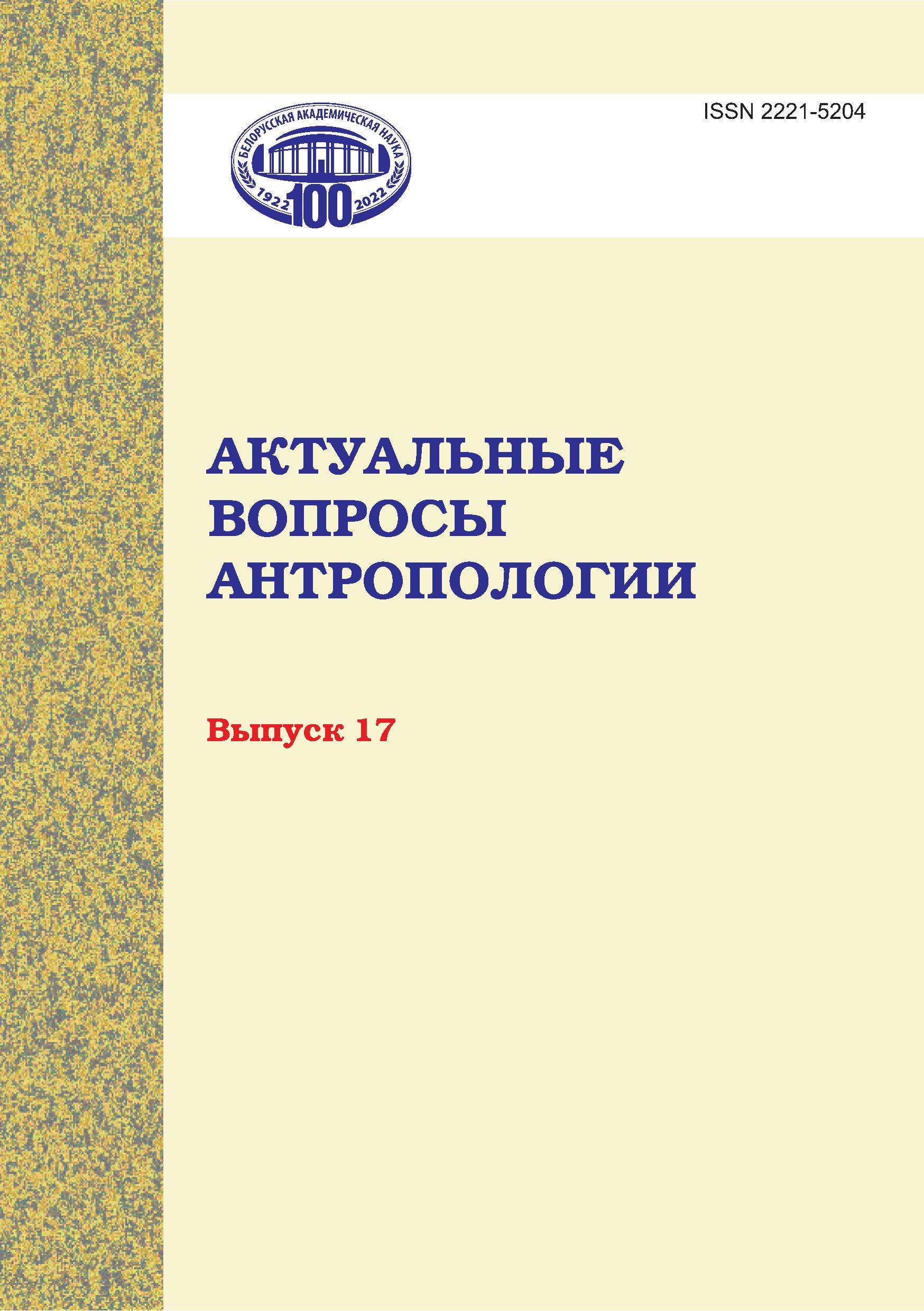 |
Актуальные вопросы антропологии: Сборник научных трудов. — Вып. 17. — Минск: Беларус. навука, 2022. — 363 с. Сборник представляет собой многопрофильное и междисциплинарное научное издание, посвященное исследованиям в области исторической и биологической антропологии: морфологии человека, конституционологии, палеоантропологии, палео- и исторической демографии, палеопатологии и смежных дисциплин. В представленных статьях также освещены методологические вопросы антропологической науки. Предназначен для антропологов, историков, философов, психологов, биологов, педагогов, аспирантов, магистрантов, студентов, а также для широкого круга читателей. Содержание сборника № 17 / Скачать. |
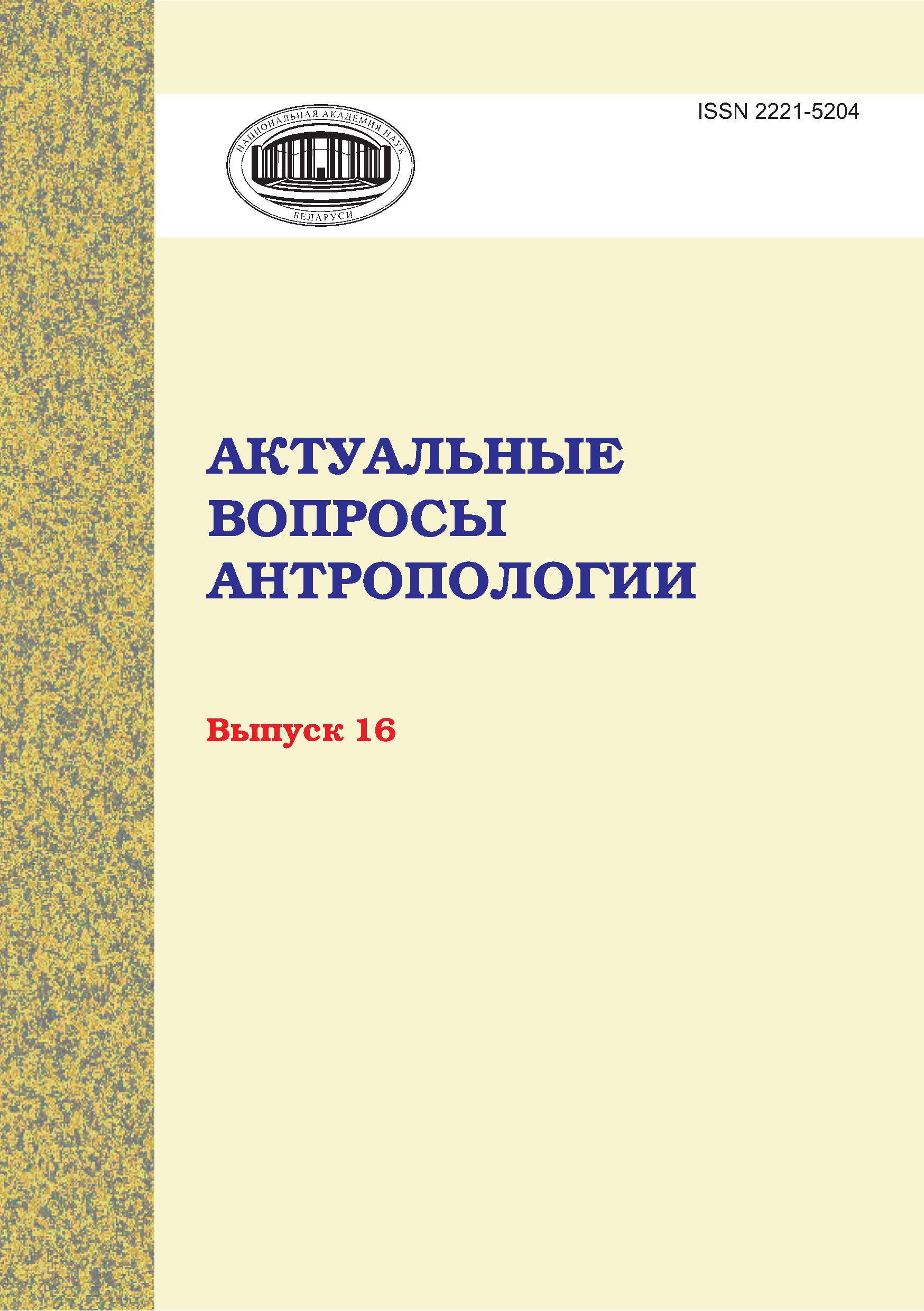 |
Актуальные вопросы антропологии: Сборник научных трудов. — Вып. 16. — Минск: Беларус. навука, 2021. — 399 с. Сборник содержит статьи по важнейшим направлениям современной антропологической науки. Результаты исследований представлены в историческом и биологическом разделах. В сборнике освещены методологические вопросы антропологической науки; затронуты различные аспекты частных направлений: морфологии человека, конституционологии, палеоантропологии и т.д.; кроме того, представлены смежные и междисциплинарные области исследования. Предназначен для специалистов разных областей знаний — антропологов, историков, философов, психологов, педагогов, биологов, а также для широкого круга читателей. Содержание сборника № 16 / Скачать. |
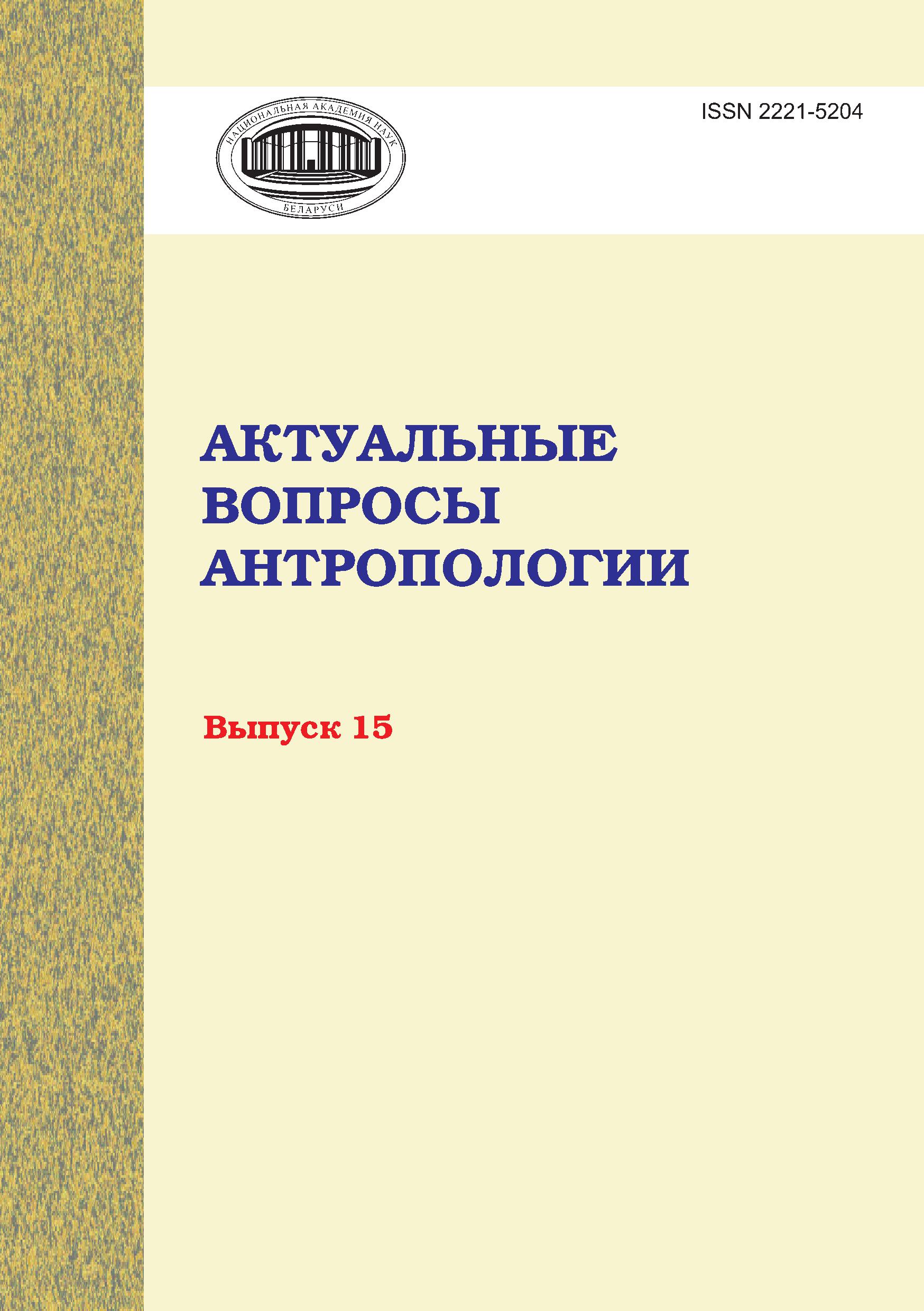 |
Актуальные вопросы антропологии: Сборник научных трудов. — Вып. 15. — Минск: Беларус. навука, 2020. — 408 с. Сборник содержит статьи по важнейшим направлениям современной антропологической науки. Результаты исследований представлены в историческом и биологическом разделах. В сборнике освещены методологические вопросы антропологической науки; затронуты различные аспекты частных направлений: морфологии человека, конституционологии, палеоантропологии и т.д.; кроме того, представлены смежные и междисциплинарные области исследования. Предназначен для специалистов разных областей знаний — антропологов, историков, философов, психологов, педагогов, биологов, а также для широкого круга читателей. Содержание сборника № 15 / Скачать. |
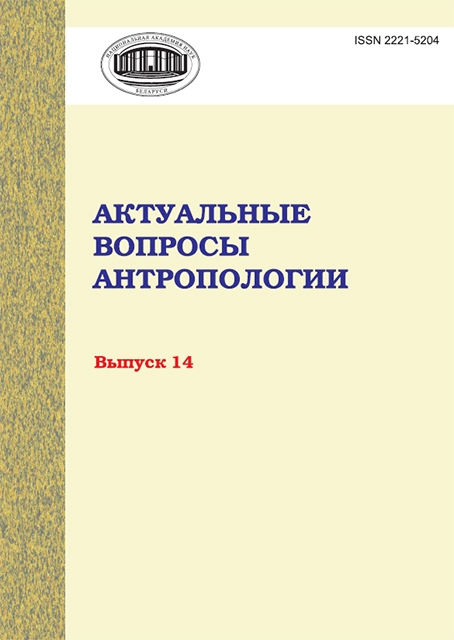 |
Актуальные вопросы антропологии: Сборник научных трудов. — Вып. 14. — Минск: Беларус. навука, 2019. — 442 с. Сборник содержит статьи по важнейшим направлениям современной антропологической науки. Результаты исследований представлены в историческом, биологическом и медицинском разделах. Помимо классических проблем антропологии рассматриваются экологические аспекты здоровья, а также вопросы развития морфофункциональных систем организма при занятиях спортом. Предназначен для специалистов разных областей знаний — антропологов, историков, философов, психологов, педагогов, биологов и медиков, а также для широкого круга читателей. Содержание сборника № 14 / Скачать. |
 |
Актуальные вопросы антропологии: Сборник научных трудов. — Вып. 13. — Минск: Беларус. навука, 2018. — 456 с. Сборник содержит статьи по важнейшим направлениям современной антропологической науки. Результаты исследований представлены в историческом, биологическом и медицинском разделах. Помимо классических проблем антропологии рассматриваются экологические аспекты здоровья, а также вопросы развития морфофункциональных систем организма при занятиях спортом. Предназначен для специалистов разных областей знаний — антропологов, историков, философов, психологов, педагогов, биологов и медиков, а также для широкого круга читателей. Содержание сборника № 13 / Скачать. |
 |
Актуальные вопросы антропологии: Сборник научных трудов. — Вып. 12. — Минск: Беларус. навука, 2017. — 345 с. В сборнике представлены работы, отражающие результаты современных исследований в области исторической, биологической и медицинской антропологической науки. Наряду с классическими проблемами антропологии древнего и современного населения рассмотрены прикладные вопросы, связанные с антропологическими направлениями в философии, психологии и педагогике, со спортивной антропологией. Материалы научного сборника представляют интерес для специалистов разных отраслей знаний — антропологов, историков, биологов, медиков, философов, психологов и педагогов, а также предназначены для широкого круга читателей, интересующихся проблемами человека. Содержание сборника № 12 / Скачать. |
 |
Актуальные вопросы антропологии: Сборник научных трудов. — Вып. 11. — Минск: Беларус. навука, 2016. — 498 с. В сборнике представлены статьи, посвященные результатам новейших исследований по исторической, биологической и медицинской тематике, а также по направлениям, смежным с антропологией как интегративной наукой. Особое внимание уделено методологии и новым методическим приемам анализа материалов по древнему и современному населению. Предназначен для специалистов разных отраслей знаний — антропологов, историков, биологов, медиков, педагогов, а также для широкого круга читателей, интересующихся проблемами человека. Содержание сборника № 11 / Скачать. |
 |
Актуальные вопросы антропологии: Сборник научных трудов. — Вып. 10. — Минск: Беларус. навука, 2015. — 602 с. Представлены результаты исследований последних лет по трем важнейшим направлениям антропологии: историческому, биологическому и медицинскому, а также по смежным областям. Рассмотрены вопросы применения новых методических подходов в изучении древнего и современного населения. Предназначен для антропологов, историков, биологов, медиков, педагогов, этнографов. Будет интересен широкому кругу читателей, интересующихся проблемами происхождения, роста и развития человека. Актуальные вопросы антропологии № 10 / Скачать. |
 |
Актуальные вопросы антропологии: Сборник научных трудов. — Вып. 9. — Минск: Беларус. навука, 2014. — 414 с. Антропологическая наука в современном мире активно развивается: совершенствуются подходы к исследованиям; интегрируются знания, относящиеся к различным научным отраслям. Так, фиксируется появление новых направлений, объединяющих области биологических, медицинских и гуманитарных знаний: биоархеология, соматопсихология и др. В настоящем сборнике освещены методологические вопросы антропологической науки: затронуты различные аспекты частных направлений: морфологии человека, конституционологии, палеоантропологии и т. д.; кроме того, представлены смежные и междисциплинарные области исследования. Представляет интерес для антропологов, философов, криминалистов, биологов, медиков, историков, этнографов и других специалистов, интересующихся проблемами человека. Актуальные вопросы антропологии № 9 / Скачать. |
 |
Актуальные вопросы антропологии: Сборник научных трудов. — Вып. 8. — Минск: Беларус. навука, 2013. — 512 с. 2013 г. объявлен Президентом Республики Беларусь годом экологической культуры и охраны окружающей среды в странах СНГ. В связи с этим в сборнике на первый план вынесены работы белорусских и зарубежных ученых, посвященные экологии человека, а также рассмотрены результаты региональных антропологических исследований. Представляет интерес для антропологов, философов, криминалистов, биологов, медиков, историков, этнографов и других специалистов, интересующихся проблемами человека. Актуальные вопросы антропологии № 8 / Скачать. |
 |
Актуальные вопросы антропологии: Сборник научных трудов. — Вып. 7. — Минск: Беларус. навука, 2012. — 492 с. Наряду с теоретическими проблемами антропологической науки рассматриваются прикладные аспекты возможности применения генетических и морфологических маркеров для профориентации и прогнозирования различных состояний. Представляет интерес для антропологов, философов, криминалистов, биологов, медиков, историков, этнографов и других специалистов, интересующихся проблемами человека. Актуальные вопросы антропологии № 7 / Скачать. |
 |
Актуальные вопросы антропологии: Сборник научных трудов. — Вып. 6. — Минск: Беларус. навука, 2011. — 600 с. Наряду с теоретическими проблемами антропологической науки рассматриваются прикладные аспекты возможности применения генетических и морфологических маркеров для профориентации и прогнозирования различных состояний. Представляет интерес для антропологов, философов, криминалистов, биологов, медиков, историков, этнографов и других специалистов, интересующихся проблемами человека. Актуальные вопросы антропологии № 6 / Скачать. |
 |
Актуальные вопросы антропологии: Сборник научных трудов. — Вып. 5. — Минск: Беларус. навука, 2010. — 448 с. Наряду с теоретическими проблемами антропологической науки рассматриваются прикладные аспекты возможности применения генетических и морфологических маркеров для профориентации и прогнозирования различных состояний. Представляет интерес для антропологов, философов, криминалистов, биологов, медиков, историков и этнографов. Актуальные вопросы антропологии № 5 / Скачать. |
 |
Актуальные вопросы антропологии: Сборник научных трудов. — Вып. 4. — Минск: Беларус. навука, 2009. — 444 с. В сборнике наряду с теоретическими проблемами антропологической науки рассматриваются прикладные аспекты возможности применения генетических и морфологических маркеров для профориентации и прогнозирования различных состояний. Представляет интерес для антропологов, философов, криминалистов, биологов, медиков, историков и этнографов. Актуальные вопросы антропологии № 4 / Скачать. |
 |
Актуальные вопросы антропологии: Сборник научных трудов. — Вып. 3. — Минск: Право и экономика, 2008. — 262 с. Наряду с теоретическими проблемами антропологической науки рассматриваются прикладные аспекты возможности применения генетических и морфологических маркеров для профориентации и прогнозирования различных состояний. Представляет интерес для антропологов, философов, криминалистов, биологов, медиков, историков и этнографов. Актуальные вопросы антропологии № 3 / Скачать. |
|
Актуальные вопросы антропологии: Сборник научных трудов. — Вып. 2. — Минск: Право и экономика, 2008. — 328 с. Наряду с теоретическими проблемами антропологической науки рассматриваются прикладные аспекты возможности применения генетических и морфологических маркеров для профориентации и прогнозирования различных состояний. Представляет интерес для антропологов, философов, криминалистов, биологов, медиков, историков и этнографов. Актуальные вопросы антропологии № 2 / Скачать. |
 |
Актуальные вопросы антропологии: мат. Межд. науч.-практ. конф. «Генетические и морфологические маркеры в антропологии, криминалистике и медицине». г. Минск, 15-17 июня 2005 г. / НАН Беларуси. — Минск: Право и экономика, 2006. — 280 с. Наряду с теоретическими проблемами антропологической науки рассматриваются прикладные аспекты возможности применения генетических и морфологических маркеров для профориентации и прогнозирования различных состояний. Представляет интерес для антропологов, философов, криминалистов, биологов, медиков, историков и этнографов. Актуальные вопросы антропологии № 1 / Скачать. |